

Puncture-resistant vacuum packaging is not just about picking a thicker bag. If you process bone-in poultry, package heavy metal castings, or export sharp-edged industrial components, you already know the frustration: bags that test fine in the factory but leak on the customer's line, product returns, and wasted trial-and-error cycles.
The right puncture-resistant vacuum packaging is determined not by thickness or barrier grade alone, but by matching the film's multi-layer structure, sealing window, and mechanical properties to the specific product geometry, equipment settings, and real-world handling conditions. A structured evaluation—covering contact points, sharp edges, load, sealing compatibility, and validated trials—replaces guesswork with evidence.
Below, I break down why common assumptions about film thickness fail, how we diagnosed a real-world leak on a chicken-packaging line, and what procurement teams should demand before committing to a supplier. Whether you package food or industrial goods, the evaluation framework is more similar than you might expect—but the specifications should never be identical.
Why Doesn't Thicker Film Automatically Mean Better Puncture Resistance?
This is the most expensive misconception in vacuum packaging procurement. Teams upgrade to a thicker gauge, assume the problem is solved, and then face the same leaks three shipments later.
Thickness adds material, but puncture resistance depends on the structure and orientation of each layer in a co-extruded film, not just the total micron count.1 A well-engineered 7-layer film at 120 µm can outperform a poorly structured monolayer or 3-layer film at 160 µm2 because of how the PA (nylon) and tie layers distribute and absorb point-load stress.
How Layer Structure Determines Puncture Performance
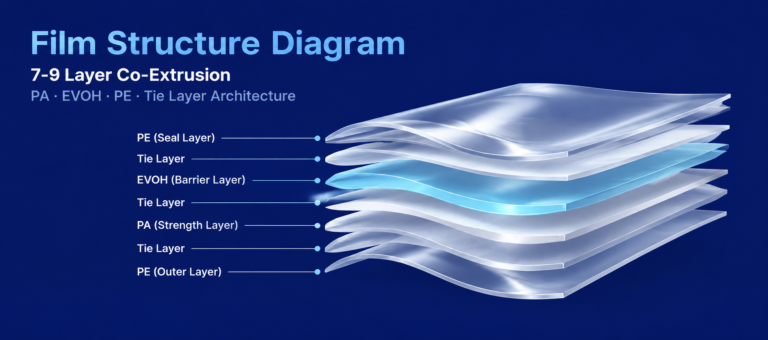
In our 7–9-layer co-extruded films, each layer has a distinct mechanical or functional role:
| Layer Type | Primary Role | Contribution to Puncture Resistance |
|---|---|---|
| Outer PE | Heat-seal surface, chemical resistance | Provides initial elasticity at contact point |
| Tie layers | Interlayer adhesion | Prevents delamination under stress—critical for maintaining film integrity around sharp objects3 |
| PA (Nylon) | Mechanical strength, flex-crack resistance | Core puncture and abrasion resistance; absorbs and distributes point loads4 |
| EVOH (if present) | Oxygen barrier | Minimal direct puncture role, but maintains barrier after the PA absorbs impact |
| Inner PE | Product contact, sealing | Determines seal strength and food-contact compliance |
A film with two or three PA layers distributed across the cross-section resists puncture very differently from one with a single thick PA core. Multiple PA layers create redundancy: if one layer is compromised at a bone tip or a sharp metal edge, adjacent layers maintain the envelope's integrity.5
What Procurement Teams Should Ask
Rather than comparing supplier quotes by total thickness, ask for:
- Layer ratio disclosure: What percentage of the total thickness is PA versus PE?
- Puncture test data referencing a named method (e.g., ASTM D4833, ASTM F1306, or EN 14477). Without a method reference, numbers are not comparable across suppliers.6
- Flex-crack and Gelbo flex test results if the product involves repeated bending during handling or transport.
Key takeaway: A 7-layer film at moderate thickness with optimized PA placement can deliver better puncture resistance than a thicker film with fewer functional layers. Always compare layer architecture, not just micron readings.
I have seen procurement teams spend months negotiating prices on heavier-gauge bags only to discover the root cause was not the film at all. Which brings us to the most instructive example I can share.
What Caused a Bone-In Chicken Packaging Line to Leak — And Was It Really the Bone?
One of our customers—a poultry processor—reported persistent leaks in bone-in chicken vacuum bags. Their assumption was straightforward: the bones were puncturing the film. They asked us to supply a heavier, more puncture-resistant bag. Before we shipped new samples, we proposed a joint investigation. What we found reshaped how I approach every packaging complaint.
The root cause of the leak was not bone puncture. It was a mismatch between the sealing machine's temperature settings and the film's sealing window, compounded by a slight change in the customer's loading procedure.
Step-by-Step: How We Diagnosed the Problem
Here is the process we followed, anonymized but technically accurate:
-
Factory-side verification. We ran the same batch of film on our own sealing equipment with bone-in chicken samples. Bags sealed properly. No leaks detected in water-bath immersion testing. This told us the film itself was not deficient.
-
Customer-line observation. We asked the customer to send us their sealing parameters (temperature, dwell time, vacuum level) and photos of the sealed area on leaked bags. The seal lines showed inconsistent width and occasional wrinkling7—classic signs of temperature or dwell-time issues, not puncture.
-
Parameter adjustment. We provided a recommended sealing-window range for that specific film structure. The customer's machine was running at the upper edge of the temperature range, which was causing the inner PE layer to thin excessively at the seal, creating weak points8. We recommended reducing the seal bar temperature by approximately 8–10 °C and increasing dwell time by 0.3 seconds.
-
Loading procedure review. The customer had recently switched to a faster loading method that occasionally left bone ends closer to the seal zone. We recommended a minimum clearance of 15 mm between the product edge and the seal line.
-
Retest with controlled conditions. The customer ran a 500-bag trial at the adjusted settings. Leak rate dropped from roughly 6–8% to below 0.5%.
What This Example Teaches About Puncture-Resistant Vacuum Packaging
- Leaks have multiple causes. Bone puncture, seal failure, equipment mismatch, loading error, and handling damage can all produce the same symptom: a bag that loses vacuum.9
- Diagnosis must precede material upgrades. Shipping a heavier bag would have increased cost without solving the seal-temperature issue.
- Sealing window compatibility is a film specification, not just a machine setting. Different multi-layer structures have different optimal temperature ranges, and a film that works on one brand of chamber sealer may require recalibration on another.
If your supplier's first response to a leak complaint is to quote you a thicker bag, consider whether the investigation has been thorough enough.
Yes—but only the framework, not the specification. I work with customers packaging everything from frozen chicken thighs to cast-iron automotive parts to stainless steel fittings. The questions I ask at the start of every project are remarkably similar. The answers, and therefore the film recommendations, are always different.
The shared evaluation framework covers contact-point geometry, edge sharpness, product weight, friction during transit, sealing requirements, and downstream handling conditions. Food hygiene, regulatory compliance, and line speed add layers of complexity for meat processors, while gross product weight and transport vibration dominate the industrial side.
The Shared Evaluation Checklist
| Evaluation Factor | Bone-In Meat Example | Heavy Industrial Part Example |
|---|---|---|
| Contact point geometry | Exposed bone tips, joint angles | Sharp casting flash, bolt threads, machined edges |
| Product weight per bag | Typically 0.5–5 kg | Can exceed 10–30 kg or more |
| Internal friction/movement | Minimal after vacuum draw | Parts may shift during palletization and transport |
| Seal integrity requirements | Must maintain vacuum for shelf life and food safety | Must maintain vacuum for corrosion protection over weeks or months |
| Handling severity | Cold-chain logistics, stacking, retail display | Forklift handling, ocean freight vibration, warehouse drops |
| Regulatory/hygiene | Food-contact compliance (e.g., EU 10/2011, FDA 21 CFR), migration limits | Typically no food-contact requirement; focus on VCI compatibility or cleanliness |
| Sealing equipment | Chamber vacuum sealers, thermoformers, flow-wrap lines | Often chamber sealers or manual impulse sealers with longer cycle times |
Where the Paths Diverge
For bone-in meat:
- The PA layers must resist slow puncture from bone tips under sustained vacuum pressure. Flex-crack resistance matters because bags bend around irregular shapes.
- Film must maintain oxygen and moisture barrier throughout refrigerated or frozen shelf life—this is where EVOH or high-PA structures become essential.
- Seal must withstand thermal cycling (freezing, thawing, re-chilling in display cases) without channel leaks.
For heavy industrial parts:
- The dominant stress is abrasion and impact rather than slow-point puncture. Parts are heavier, handling is rougher, and transit distances are longer.
- Barrier requirements may focus on moisture and corrosion prevention rather than oxygen transmission rates relevant to food spoilage.
- Sealing equipment on an industrial floor often differs from food-processing lines. Seal bar width, pressure, and temperature tolerances may be less precise, so the film's sealing window must be wider to tolerate variation.
Why One Universal Specification Fails
I have had industrial customers request the same film we supply to a food processor, reasoning that "if it handles bones, it handles metal parts." In practice, a 2 kg chicken thigh and a 15 kg cast-iron housing impose completely different load distributions, abrasion patterns, and sealing demands. The food-grade film may be over-specified on barrier and under-specified on impact resistance for the industrial application—and it costs more due to food-contact compliance the industrial customer does not need.
Recommendation: Use the shared framework to define the problem, but always validate the solution with application-specific trials. Do not extrapolate from one product category to another.
What Should a Meaningful Trial Look Like Before You Commit to a Supplier?
Samples are easy to send. Meaningful trials are harder to design. I have seen too many supplier evaluations reduced to "send us 50 bags, we'll test on Monday." That approach leaves critical variables uncontrolled and produces unreliable conclusions.
A valid puncture-resistant vacuum packaging trial must reproduce the actual product geometry, loading method, sealing conditions, storage environment, and downstream handling the bags will face in commercial use.10 Anything less is a thickness comparison, not a performance evaluation.
Elements of a Rigorous Supplier Trial
1. Use the actual product—not a substitute. A boneless chicken breast does not test what a bone-in thigh tests. A smooth steel bar does not replicate the stress from a rough-cast iron bracket. If you cannot ship your actual product to the supplier, provide detailed geometry data, photographs, weight, and if possible a 3D-printed or otherwise representative mock-up.
2. Run on the actual sealing equipment. Film A on Machine X at Setting Y is a different system than Film A on Machine Z at Setting Y. Request that the supplier provide recommended sealing parameters (temperature range, dwell time, vacuum level, gas-flush ratio if MAP) for your specific machine brand and model.
3. Define pass/fail criteria before the trial begins. Examples:
- Maximum acceptable leak rate (e.g., ≤ 0.5% in water-bath immersion per ASTM D3078)
- Minimum seal strength (e.g., ≥ 25 N/15 mm per ASTM F88)
- No visible delamination or puncture after simulated drop test (e.g., ISTA 2A or customer-defined protocol)
4. Simulate real handling. Stack the sealed bags as they would be stacked in shipping cartons. Subject them to vibration if they will travel by truck or ocean freight. Freeze them if they enter cold chain. The bag that survives a gentle lab environment may fail after 14 days on a container ship.
5. Document and share results transparently. A good supplier will share failure analysis, not just success counts. If 3 out of 100 bags leaked in the trial, the supplier should help you understand where the failure occurred (seal zone, film body, corner stress point) and why.
What to Watch Out For
- Suppliers who only compare thickness without disclosing layer structure or test methodology.
- Trials run exclusively at the supplier's factory without replication on your equipment.
- Claims of "puncture-proof" or "guaranteed leak-free" performance. No film is puncture-proof under all conditions. Performance is application- and test-dependent.
- Absence of sealing-window data. If a supplier cannot tell you the recommended seal temperature range for their film on your machine type, they have not tested compatibility.
Frequently Asked Questions
Does adding an EVOH layer improve puncture resistance?
Not directly. EVOH is an oxygen-barrier layer, not a structural reinforcement layer.11 It dramatically reduces oxygen transmission to extend shelf life or prevent corrosion, but puncture resistance comes primarily from the PA (nylon) layers and the overall layer distribution. A film can have excellent barrier and poor puncture resistance, or vice versa.
Can I use the same vacuum bag for bone-in chicken and frozen bone-in pork ribs?
Not necessarily. Pork ribs have sharper, more exposed bone edges than chicken thighs and are typically heavier per package. The contact-point geometry and load per bag differ enough that a film validated for chicken may underperform for ribs. Run a separate trial with the actual rib product before committing.
How do I know if a leak was caused by puncture or by a bad seal?
Inspect the leaked bag carefully. Puncture failures appear as small holes or tears in the film body, usually near a sharp contact point. Seal failures show as open channels, wrinkles, or delamination along the seal line. A water-bath immersion test (per ASTM D3078) can help locate the leak source. If most failures cluster at the seal zone, investigate machine settings before upgrading the film.
What is a "sealing window" and why does it matter for puncture-resistant films?
A sealing window is the range of temperature and dwell time within which a film forms a reliable seal.12 Multi-layer co-extruded films have narrower or wider sealing windows depending on their PE blend and layer ratios. If your equipment operates outside the film's window—even by a few degrees—seals weaken, and you may misdiagnose the resulting leaks as puncture failures.
Should industrial parts packaging use food-grade film for extra safety?
Generally, no. Food-grade films carry regulatory compliance costs (migration testing, food-contact certifications) that add no value for non-food applications. Industrial packaging should be specified for the actual stresses—weight, abrasion, corrosion protection, transit duration—rather than defaulting to a food-grade product that may be over-specified on barrier and under-specified on mechanical strength.
Conclusion
Selecting puncture-resistant vacuum packaging for bone-in meat or heavy industrial parts is a systems decision, not a thickness decision. The right film depends on your product's geometry, your sealing equipment's parameters, your handling chain's severity, and validated trial results—not catalog comparisons.
I have seen firsthand how a thorough leak investigation can save a customer from unnecessary material upgrades. Diagnosing whether the issue is puncture, seal failure, or equipment mismatch is always the first step. Whether you process poultry, export automotive castings, or convert film for downstream customers, start with the evaluation framework, demand application-specific trials, and verify every performance claim against a named test method.
At Qianxun New Material, we manufacture 7–9-layer co-extruded films with customizable PA and EVOH layer configurations. If you are evaluating puncture-resistant vacuum packaging for a demanding application, send us your product details and sealing equipment specifications—we will recommend a structure, provide samples, and support trials on your actual production line. That is how packaging decisions should be made.
"Recycling Polyethylene/Polyamide Multilayer Films with Poly ...", https://pmc.ncbi.nlm.nih.gov/articles/PMC11053548/. Studies of multilayer polymer films identify resin composition, molecular orientation, interlayer adhesion, and layer arrangement as determinants of puncture and tear behavior, indicating that total thickness alone does not predict mechanical performance. Evidence role: mechanism; source type: paper. Supports: Research comparing polymer films should show that puncture behavior is influenced by polymer composition, layer arrangement, interfaces, and orientation in addition to overall thickness.. Scope note: The cited research may establish the general mechanism without evaluating the exact film formulations discussed in the article. ↩
"Development of Mono-Material Multilayer Light Barrier Films", https://pmc.ncbi.nlm.nih.gov/articles/PMC12736824/. Comparative studies of flexible films show that mechanical performance is not necessarily proportional to nominal thickness and that multilayer structures can outperform thicker monolayers when their constituent polymers and interfaces are optimized. Evidence role: general_support; source type: paper. Supports: Comparative research should demonstrate that a thinner multilayer structure can outperform a thicker film when polymers and layer architecture differ.. Scope note: Such evidence supports the possibility of the comparison but does not verify the article's exact 120 µm and 160 µm formulations without product-specific test results. ↩
"Evaluation of Recyclable Multilayer Packaging Designs ... - PMC", https://pmc.ncbi.nlm.nih.gov/articles/PMC12446127/. Tie layers are employed to bond polymer layers with limited mutual compatibility, and adequate interfacial adhesion helps prevent delamination when a multilayer film is mechanically deformed. Evidence role: mechanism; source type: paper. Supports: Research should explain how tie layers promote adhesion between otherwise incompatible polymers and how weak interfaces can lead to delamination under stress.. Scope note: Preventing delamination preserves structural cohesion, but it does not by itself establish resistance to every sharp-object puncture condition. ↩
"Development of Mono-Material Multilayer Light Barrier Films", https://pmc.ncbi.nlm.nih.gov/articles/PMC12736824/. Polyamide is used in flexible multilayer packaging for its comparatively high strength, toughness, and abrasion resistance, properties that can improve resistance to concentrated mechanical loads. Evidence role: mechanism; source type: paper. Supports: Materials research should document the toughness, tensile behavior, abrasion resistance, and puncture contribution of polyamide in flexible multilayer packaging.. Scope note: The magnitude of the benefit depends on polyamide grade, moisture conditioning, layer thickness, orientation, and the other polymers in the structure. ↩
"Recyclability and Redesign Challenges in Multilayer Flexible ...", https://pmc.ncbi.nlm.nih.gov/articles/PMC8624454/. Research on layered polymers indicates that interfaces and distributed tough layers can alter crack propagation and improve damage tolerance by deflecting or arresting localized fractures. Evidence role: mechanism; source type: paper. Supports: Fracture research should show whether multiple layers and interfaces can deflect or arrest cracks and preserve residual integrity after localized damage.. Scope note: This mechanism does not prove that an adjacent polyamide layer will always retain vacuum after another layer is penetrated; that outcome requires testing of the complete film and package. ↩
"Puncture Testing Solutions | ADMET", https://www.admet.com/applications/testing-solutions-by-test-type/puncture-testing-solutions/. Standardized puncture methods specify variables such as probe geometry, specimen support, penetration rate, conditioning, and reported result; values generated under materially different procedures are therefore not directly interchangeable. Evidence role: general_support; source type: institution. Supports: Standards documentation should establish that ASTM D4833, ASTM F1306, and EN 14477 define different puncture procedures and test parameters.. Scope note: Even results from the same named method may remain non-comparable if laboratories use different permitted options, specimen conditioning, or reporting conventions. ↩
"Heat sealing evaluation and runnability issues of flexible ...", https://bioresources.cnr.ncsu.edu/resources/heat-sealing-evaluation-and-runnability-issues-of-flexible-paper-materials-in-a-vertical-form-fill-seal-packaging-machine/. Heat-seal studies identify wrinkles and nonuniform seal geometry as potential pathways for channel leaks and associate them with variability in temperature, dwell time, pressure, alignment, and seal-area condition. Evidence role: mechanism; source type: research. Supports: Packaging research should connect wrinkles and nonuniform seal geometry with channel formation and variability in heat, pressure, dwell time, alignment, or contamination.. Scope note: Visual appearance alone cannot identify the precise cause of a leak or exclude a separate puncture elsewhere in the package. ↩
"Heat sealing evaluation and runnability issues of flexible ...", https://bioresources.cnr.ncsu.edu/resources/heat-sealing-evaluation-and-runnability-issues-of-flexible-paper-materials-in-a-vertical-form-fill-seal-packaging-machine/. Heat-sealing research shows that conditions above an appropriate process range can produce excessive sealant flow, distortion, or thinning, leading to weak regions even though sufficient heat is necessary to initiate interfacial bonding. Evidence role: mechanism; source type: paper. Supports: Heat-sealing research should document how excessive temperature, pressure, or dwell can cause sealant flow, distortion, thinning, or reduced strength.. Scope note: The mechanism is general and does not independently establish that overheating caused the leak in the anonymized customer case. ↩
"Leakage assessment of flexible pouches using dye ... - PMC", https://pmc.ncbi.nlm.nih.gov/articles/PMC6049556/. Package-integrity guidance recognizes that leakage may originate in the package body, seal area, closures, process conditions, contamination, or damage incurred during handling and distribution. Evidence role: general_support; source type: government. Supports: Authoritative package-integrity guidance should identify both seal-related and material-related pathways through which flexible packages lose integrity.. Scope note: The presence of multiple recognized failure modes does not determine which mode caused any individual leak; localization and failure analysis are still required. ↩
"Getting Started with Design & Testing", https://www.ista.org/getting_started_with_design.php. Recognized distribution-test frameworks base laboratory simulation on the packaged product and its anticipated distribution cycle, including handling, compression, vibration, impact, and relevant environmental conditioning. Evidence role: expert_consensus; source type: institution. Supports: Distribution-testing standards should support designing trials around the actual packaged product and anticipated handling, vibration, impact, stacking, and environmental conditions.. Scope note: Standard simulations approximate selected hazards and cannot reproduce every commercial event or guarantee field performance. ↩
"a review of barrier properties for packaging shelf stable foods", https://pubmed.ncbi.nlm.nih.gov/22530715/. Reviews of food-packaging polymers describe ethylene-vinyl alcohol copolymer as a high oxygen-barrier material commonly embedded between other polymers, with its principal packaging function being gas-barrier performance rather than puncture reinforcement. Evidence role: mechanism; source type: paper. Supports: A packaging-materials review should establish that EVOH is valued chiefly for low oxygen permeability and is normally protected within multilayer structures.. Scope note: EVOH still has mechanical properties and may affect the behavior of a complete laminate, while its oxygen barrier is strongly influenced by humidity. ↩
"Heat sealing evaluation and runnability issues of flexible ...", https://bioresources.cnr.ncsu.edu/resources/heat-sealing-evaluation-and-runnability-issues-of-flexible-paper-materials-in-a-vertical-form-fill-seal-packaging-machine/. In flexible-packaging science, the heat-seal process window denotes the combinations of jaw temperature, contact time, and pressure that produce seals meeting specified strength and integrity criteria. Evidence role: definition; source type: education. Supports: Packaging-science sources should define a heat-seal process window in terms of the combinations of temperature, time, and pressure that produce acceptable seal properties.. Scope note: The article's shorter definition mentions temperature and dwell time but omits pressure and other equipment-dependent variables. ↩
Leave a Reply